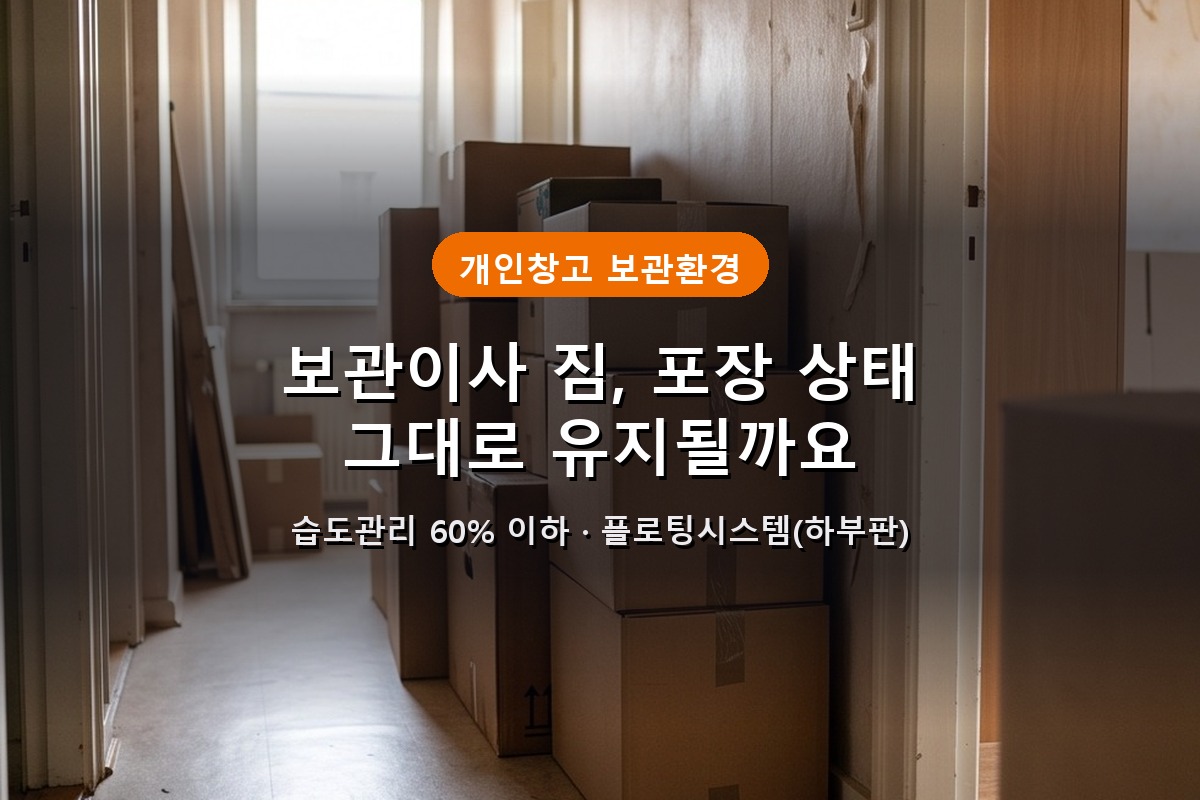
Packing for a move or a stint in storage in Korea, and everything looks buttoned up — boxes taped, labeled, stacked neatly?
Good packing takes care of one problem: things not shifting or getting crushed in transit.
It doesn’t take care of a second problem — what happens to those same boxes after they sit for a few months.

Packing well and storing well are two different jobs
Right after you finish packing, everything looks the way it should — flat corners, tight tape, nothing rattling around inside. That tells you the packing job went well. It doesn’t tell you anything about how those boxes will look in month three or month six, because packing and long-term storage are solving two completely different problems.
Packing protects against movement — bumps, drops, things shifting during the drive. What determines the condition months down the road is something packing was never designed to handle: the air and the floor the boxes sit on for that whole stretch.
Humidity gets to the box before it gets to what’s inside

Cardboard and packing tape both absorb moisture from the surrounding air, slowly, over weeks. You won’t see it happen day to day — but a box that sat through Korea’s monsoon season in a room where humidity climbed past 80% will feel noticeably softer at the corners than one that sat through the same months somewhere dry.
Once the box itself softens, whatever’s inside is next — fabric picks up a musty smell, paper starts to curl, anything metal can start to spot with rust. 편안창고 (SPACETIME) keeps humidity at 60% or below even in the middle of monsoon season, and finishes its walls with MUBIC coat, the same patented antifungal material used in museum storage.
What’s under the box matters as much as what’s around it
Humidity in the air is only half the picture. The other half is what your boxes are actually resting on. Set a box directly on a concrete floor for a few months, and ground moisture works its way upward into the cardboard from below — the exact same softening effect as humid air, just approaching from the opposite direction.
This is exactly why museum storage facilities are required to build their shelving on a raised floor system rather than letting anything sit flush against the ground. 편안창고 applies that same floating-floor system to every unit, in every size, at every branch — not as an upgrade option, but as a default.
Two different storage rooms, two different outcomes

Put the same boxes in two different storage rooms for the same six months, and you’ll get two different results — not because of anything you did differently, but because of what each room was built to manage.
| What to look at | A typical indoor storage room | 편안창고 (SPACETIME) |
|---|---|---|
| Humidity management | Often no clearly stated standard | Kept at 60% or below, even in monsoon season |
| Wall material | Ordinary finish, or none at all | MUBIC coat, patented antifungal material |
| Floor structure | Often no raised floor at all | Floating-floor system in every unit, every branch |
None of these three show up in a listing photo or a price quote. The only way to actually know is to ask directly, or check in person — and it’s worth doing that before, not after, your boxes have already spent a season somewhere you can’t see.
FAQ
Q. If I packed my boxes well, does storage humidity still matter?
Yes. Careful packing protects your items from bumps and shifting during the move, but it doesn’t seal out humidity. Cardboard and fabric both absorb moisture from the surrounding air over weeks and months, regardless of how well the box was taped.
Q. Does it matter if boxes sit directly on the floor?
It can. Concrete and other hard floors can carry ground moisture upward, and boxes sitting flat on that surface for months are the first thing to absorb it. A raised floor structure keeps items off that direct contact.
Q. How is 편안창고 (SPACETIME) different from an ordinary indoor storage room?
편안창고 manages humidity at 60% or below even during Korea’s monsoon season, uses MUBIC coat — a patented antifungal material also used in museum storage — on its walls, and applies a floating-floor system across every unit size at every branch, so nothing sits in direct contact with the floor.
The bottom line
How well you pack decides whether your things survive the move. Humidity and floor structure decide whether they survive the months after. They’re separate problems, and a storage room only solves the second one if it was actually built to.
※ Storage conditions can vary by branch and by season. Please confirm current details directly with the facility before signing a long-term contract.
Storage built to protect what’s inside the box, not just what’s around it
Humidity at 60% or below, MUBIC coat, floating-floor system in every unit
Check a branch near you anytime