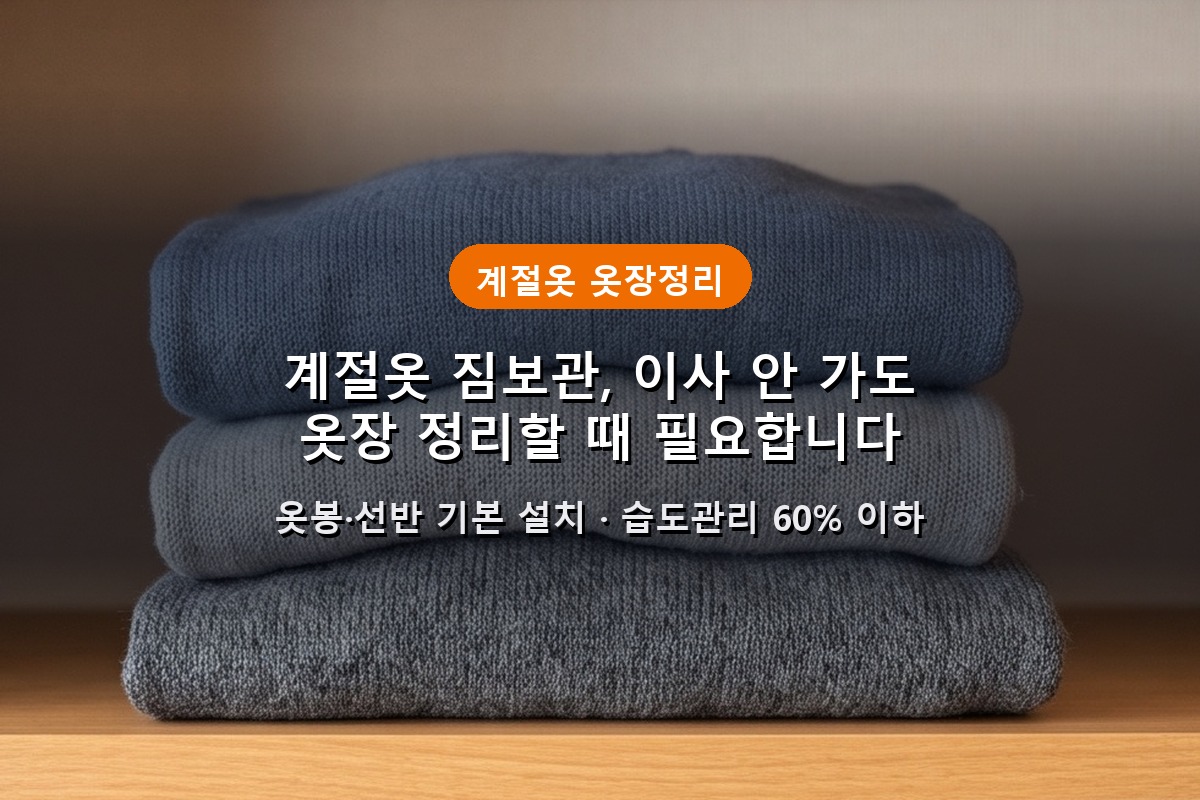
Are you living in Korea and dealing with a closet that never quite fits everything?
A lot of people assume self-storage is only for moving day — something you rent for a few weeks around a move and then cancel.
But closet management has nothing to do with moving. It repeats every single time the season changes, whether you’re relocating or not.
Here’s how to use self-storage for exactly that — no move required — and how to store clothes so they come back looking the way they went in.

Closet chaos has nothing to do with moving
Moving gives you an obvious reason to cut down on clothes and get organized. But even in a home with zero moving plans, the closet fills up the exact same way, every time the season turns. Winter arrives, summer clothes get shoved to the back; summer arrives, winter clothes get shoved back in their place — and most people repeat the same swap year after year.
Just shuffling seasonal clothes around inside the same closet isn’t really organizing — it’s a cycle that never actually resolves. The closet’s total capacity never changes, but the amount of clothing keeps growing, so every season starts with the same scramble to find room for whatever you bought since last time.
✔ The real issue: a cramped closet usually isn’t caused by moving — it’s caused by off-season clothes that never actually leave.
Storage isn’t only for people who are moving

Self-storage tends to get mentally filed under “moving,” so if you’re not relocating, it’s easy to assume it doesn’t apply to you. In practice, you can sign up any time regardless of whether a move is involved, and contracts can be as short as one month — plenty for just getting through to the next season.
Plenty of people use it exactly this way: move off-season clothing into storage, then pull it back out once the weather turns. Most operators offer 24-hour app-based access, so swapping wardrobes in and out as the seasons change is a routine, not a hassle.
Move off-season clothes out, and the whole closet opens up
Keep only what you’re actually wearing this season in the closet, and move everything else into storage — the whole push-and-shove routine disappears entirely. What’s left of the closet suddenly has plenty of room to hang or fold what you’re currently wearing.
This is where 편안창고 (SPACETIME) comes in
편안창고’s Light and Light+ sizes — built specifically for clothes storage — come with a hanging bar and shelving already installed, so nothing has to be crammed into boxes — you can hang your clothes just as you would at home. Walls and ceilings are treated with MUBIC coat, a patented antifungal material also used in museum-grade storage, which helps control mold and odors, and humidity is kept to roughly 60% or lower even through Korea’s summer monsoon season.
None of that changes based on why you’re using it — the same storage environment applies whether you’re moving or simply managing a closet.
Store it this way, and it comes back in the same shape

Wash everything before it goes into storage. Clothes put away while still carrying sweat or other residue can discolor over time regardless of how good the storage environment is — a premium unit keeps conditions stable, but it won’t do your laundry for you.
Use a breathable, non-woven cover rather than a plastic cover — plastic traps moisture inside and does more harm than good. Compression bags shrink volume effectively, but they can be harder on fabric over time, so hanging clothes is the better call whenever it’s practical.

Wash first, use a breathable cover, and hang rather than compress — do those three things and what comes out next season should look close to what went in.
| Category | Left in the closet | Moved to self-storage |
|---|---|---|
| Space | Constant push-and-shove every season | Only current-season clothes remain — closet opens up |
| How it’s stored | Compressed in boxes or vacuum bags | Hung on a bar or laid on shelving |
| Commitment | No contract needed | From 1 month, regardless of moving plans |
FAQ
Q. Can I rent a storage unit in Korea if I’m not moving?
Yes — renting has nothing to do with whether you’re moving. Contracts can typically be as short as one month or as long as twelve months, so you can rent just long enough to get through to the next season if that’s all you need.
Q. Is it okay to use vacuum compression bags for clothes in storage?
That’s really up to you. Compression bags shrink the volume significantly, but they can be harder on the fabric over time, so hanging clothes is generally the better option when it’s practical.
Q. What size storage unit is right for just clearing out a closet?
If clothing is most of what you’re storing, a size built specifically for clothes storage is usually the right fit. Exact dimensions and pricing depend on how much you have, so checking the size guide through the operator’s branch-finder app or website gives you the most accurate answer.
The bottom line
Closet management repeats every season, regardless of whether you’re moving. Move the clothes you’re not currently wearing into self-storage instead of forcing a trade inside the same closet space, and the room opens up without the constant reshuffling. Wash first, use a breathable cover, and hang rather than compress, and what you pull out next season should look close to what went in. Since you’re trusting a company with your clothes for months at a time, it’s also worth choosing an operator large and financially stable enough to still be there when you come back — a publicly listed company running its own branches directly, rather than a loosely managed franchise, is generally the safer bet.
※ The storage guidance here reflects SPACETIME’s general recommendations. Actual results depend on fabric type and how items are cared for. Check exact sizes and pricing through the operator’s app or website.
Seasonal clothes belong in self-storage — moving or not
Hanging bar and shelving included, humidity kept at 60% or below
Rent for as little as one month, for exactly as long as you need