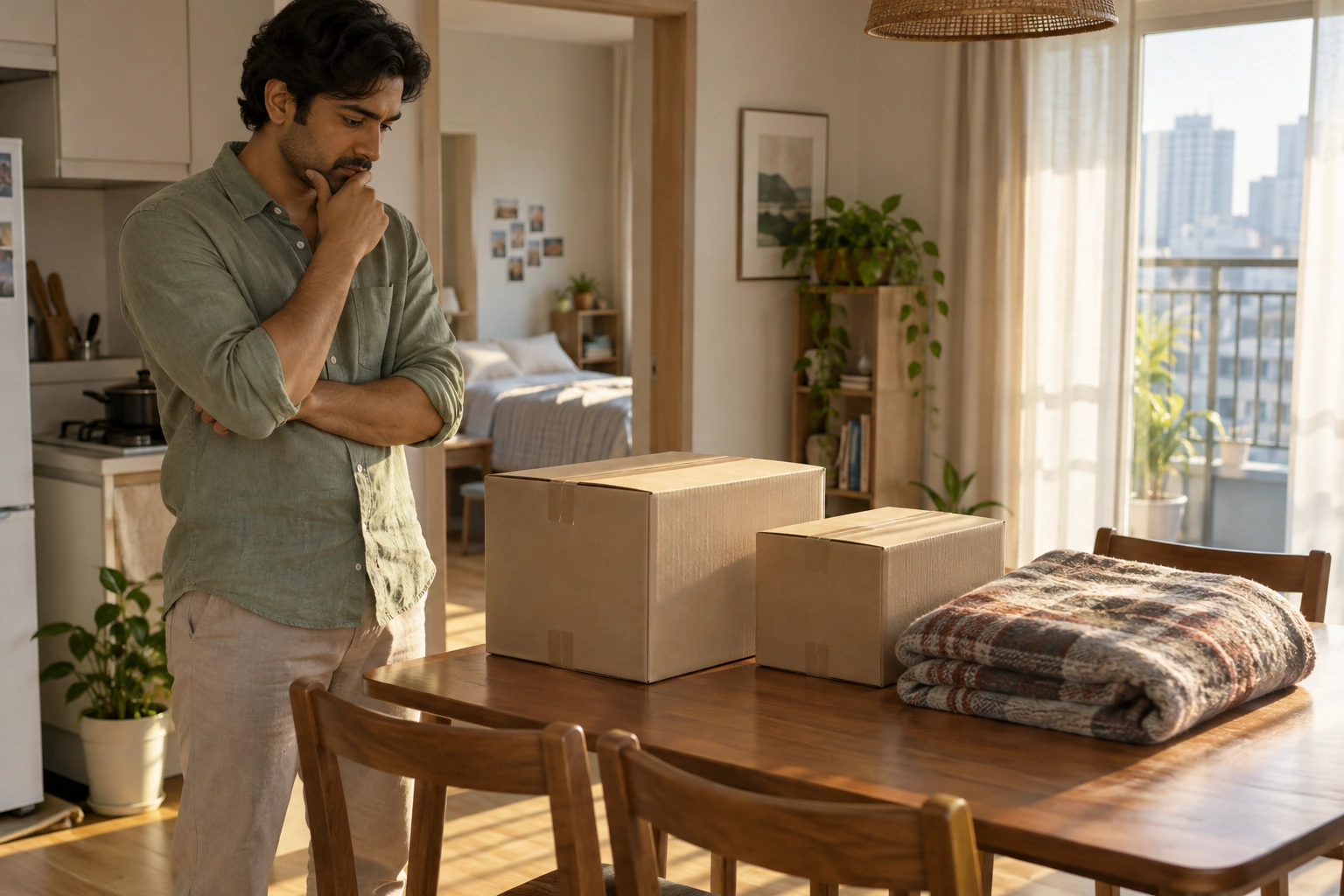
Living with less clutter does not require treating every possession as disposable. A winter coat, a favorite collection or equipment for a hobby may still have a place in your life even when it is not needed beside you every day.
During a long stay in Korea, the useful question is how your room should support the life you are living now. Start with that purpose, then decide what stays close, what is worth preserving elsewhere and what you no longer need to keep.

Begin with the daily life you want the room to support
Choose one practical improvement. You may want a desk ready for study, somewhere to eat without moving boxes or room to get dressed comfortably before work.
Look at which belongings prevent that use. Separate objects that support the routine from objects that happen to occupy the same area. A daily work bag may need a better position at home, while a large travel case may be useful only between journeys.
This makes the process personal. A room suited to someone who works remotely may need different priorities from a room used mainly for sleep between shifts. Your own routine should guide the choices rather than an idealized photograph of an almost empty apartment.
Write the improvement in a short sentence before sorting. “I want the table available for dinner” gives you a clear way to decide whether a change has helped.
Make a decision about use before choosing storage

Work through a small group rather than emptying every cupboard at once. Ask what the item is for, whether you expect to use it again and whether it needs to remain within daily reach.
Keep the decision specific. Seasonal bedding has an identifiable next use. A collection may be worth retaining because you enjoy it. Something bought for an abandoned project may need a different destination.
| Question | What it helps you decide |
|---|---|
| What purpose does this serve? | Whether it still belongs in your plans |
| When do I use it? | Whether it needs daily access |
| Why am I keeping it? | Its practical or personal value to you |
| How should it be prepared? | Care and packaging before storage |
| When will I review the decision? | A sensible point to reconsider the arrangement |
You do not need an arbitrary rule that everything unused for a fixed number of months must be discarded. Consider the item’s role in your actual life. At the same time, avoid packing an undecided pile simply because moving it out of sight is faster.
Keep useful possessions without keeping all of them in the room

Once you know what is worth retaining, separate the belongings needed now from those intended for another time. The belongings you will use later can go into storage: seasonal garments, suitable hobby equipment, prepared household items or a collection waiting for its next display.

Use a brief contents list. Record what you are keeping and why it remains useful, with enough detail to recognize the group later. A simple identifier on the carton can connect it to that private record.

Prepare the goods according to their materials and care instructions. Clean and fully dry fabrics, protect suitable fragile items and keep related parts identifiable. Check that every item complies with the provider’s current rules before including it in the load.
Then measure the packed belongings. The space should fit what you have deliberately chosen to preserve, along with the access needed for any planned collection. Choose the storage unit after making those decisions rather than filling a preselected space with whatever remains.
Preservation is part of keeping, not an afterthought
The reason to retain a possession is that you intend to use or enjoy it again. For several months of storage in Korea, consider the environment through the changing seasons as well as the room you gain at home.
Available brands include 편안창고(SPACETIME), StorHub, Boxful and Nemo Storage.

편안창고(SPACETIME)’s premium environment is informed by Sigongtech’s experience creating museums and dedicated collection-storage facilities. Choosing to retain a coat, collection or household item means choosing somewhere to preserve it until it belongs in daily life again. That is the connection between this minimalist plan and the operator’s professional field.
Start with the surface beneath your belongings: 편안창고(SPACETIME)’s Floating System gives them a separate base above the building floor. For the surrounding environment, humidity management works alongside patented museum materials coated on the walls and ceilings. The coated surfaces provide antibacterial and antifungal functions and adsorb and decompose odors and volatile organic compounds (VOCs).
Non-combustible materials, fire doors and security provisions address additional aspects of the facility. These are concrete features to consider alongside unit dimensions, rather than choosing solely on how much can be removed from the apartment at once.
Sigongtech directly runs the entire 편안창고(SPACETIME) branch network as a KOSDAQ-listed company. Its professional history and company information are relevant when choosing an operator for a sustained arrangement. Branch locations can help with convenience, while company resources and responsibility require their own assessment.
Set a review point that fits your stay

Give the arrangement a sensible point for review: the next season, the end of a work assignment or a planned move. You can then decide whether the stored items should return home, remain for a further period or take another appropriate destination.
Keep that review connected to the contract’s extension or ending requirements. If you will be abroad, retain the agreement and contents list where you can access them, and keep contact and payment details current.
Review the applicable insurance and responsibility information before booking. Compare current branch and unit options on the 편안창고(SPACETIME) website using the packed belongings and intended period.

After moving the belongings, use the recovered space for the purpose you chose at the start. Notice whether dinner is easier to prepare, the work surface stays available or the room supports the routine more comfortably.
That practical change is the measure of the plan. You have kept the things that matter, chosen suitable long-term storage conditions for them and made the room more useful for the part of life happening now.
Further reading
Related Korean-language guides: