Moved to Korea, or lived here a while, and noticed how much your closet has to work for through four genuinely distinct seasons?
Winter padding jackets, spring and fall layers, summer linens — whatever you’re not wearing has to sit somewhere, and in most Korean apartments, “somewhere” is running out fast.
Renting a small self-storage unit solves the space problem. Choosing the wrong one can create a different problem entirely.

| Contents | |
|---|---|
| 1 | Why clothes storage comes up so often in Korea |
| 2 | Why the storage environment matters more than location |
| 3 | What to check before picking an operator |
| 4 | What 편안창고 does differently |
| ✓ | FAQ |
Why clothes storage comes up so often in Korea
Korea’s four distinct seasons mean sorting through clothing is a recurring, genuine hassle. Once spring arrives, bulky winter padding and coats suddenly become dead weight cluttering the closet — and the moment winter comes back around, summer clothing has to make room somewhere fast.
For people living alone, students, or newlyweds especially, closet space is chronically tight to begin with, and a lot of people just accept the compromise: cram everything into the bed frame or a corner of the bedroom under a dust cover. The trouble is that kind of makeshift storage is bad for the clothing itself — poor ventilation and unstable temperature and humidity, sustained over a long stretch, raise the risk of fiber damage or mold significantly.
A self-storage unit solves this cleanly: rent exactly the size you need, set the term however long or short suits you, and unlike handing everything to a moving company’s bulk storage, pay only for a small dedicated clothing space with no unnecessary overhead.
Why the storage environment matters more than location

A lot of people pick a self-storage facility based on price or how close it is to home. For clothes storage specifically, though, the storage environment should be the primary decision factor.
Fabric is especially sensitive to environmental swings. Sustained high humidity raises the odds of mold forming inside the fibers themselves, and clothing left in a sealed room for a long stretch can pick up odor and discoloration even without visible mold. Facilities with weak underground drainage or lax environmental management carry a real risk of flooding or condensation damage, and poorly ventilated locations are more prone to pest issues as well.
Reports of mold forming in stored clothing, or flood damage, do come up from time to time at certain operators. That’s exactly why some people who’ve been through that kind of loss switch to a facility they trust more, specifically to avoid a repeat. If you have an operator in mind, it’s worth searching that company’s name alongside terms like “mold,” “flooding,” or “compensation” to see what history comes up before you sign.
What to check before picking an operator

As self-storage operators have multiplied across Korean cities, there’s more choice than ever — some with a large branch network, some with lower prices, some with a more convenient app. But a large branch count doesn’t guarantee that every single branch is managed to the same standard.
For franchised or licensed operators specifically, the management level can differ noticeably from one branch to the next — which is exactly why it’s worth checking whether a given location is directly operated by the parent company or run under a franchise arrangement.
Insurance structure is worth a close look too. Some operators induce customers to purchase a separate paid care package, effectively shifting the cost of insurance onto the customer. Check carefully whether comprehensive liability insurance is already built into the base contract, and whether compensation is structured so that you don’t bear any extra cost if something does go wrong.
Finally, whether the company is a publicly listed corporation with disclosed financials is a reasonable proxy for reliability. A company whose financials are externally disclosed and audited tends to offer more transparency for customers than one that isn’t.
(For reference: among Korean self-storage operators, 편안창고 — the premium brand directly operated by SIGONGTECH, a company with net assets in the hundreds of billions of won — runs around 40 branches. Some other operators in the market run just a handful of branches or are smaller, newer businesses.)
What 편안창고 does differently

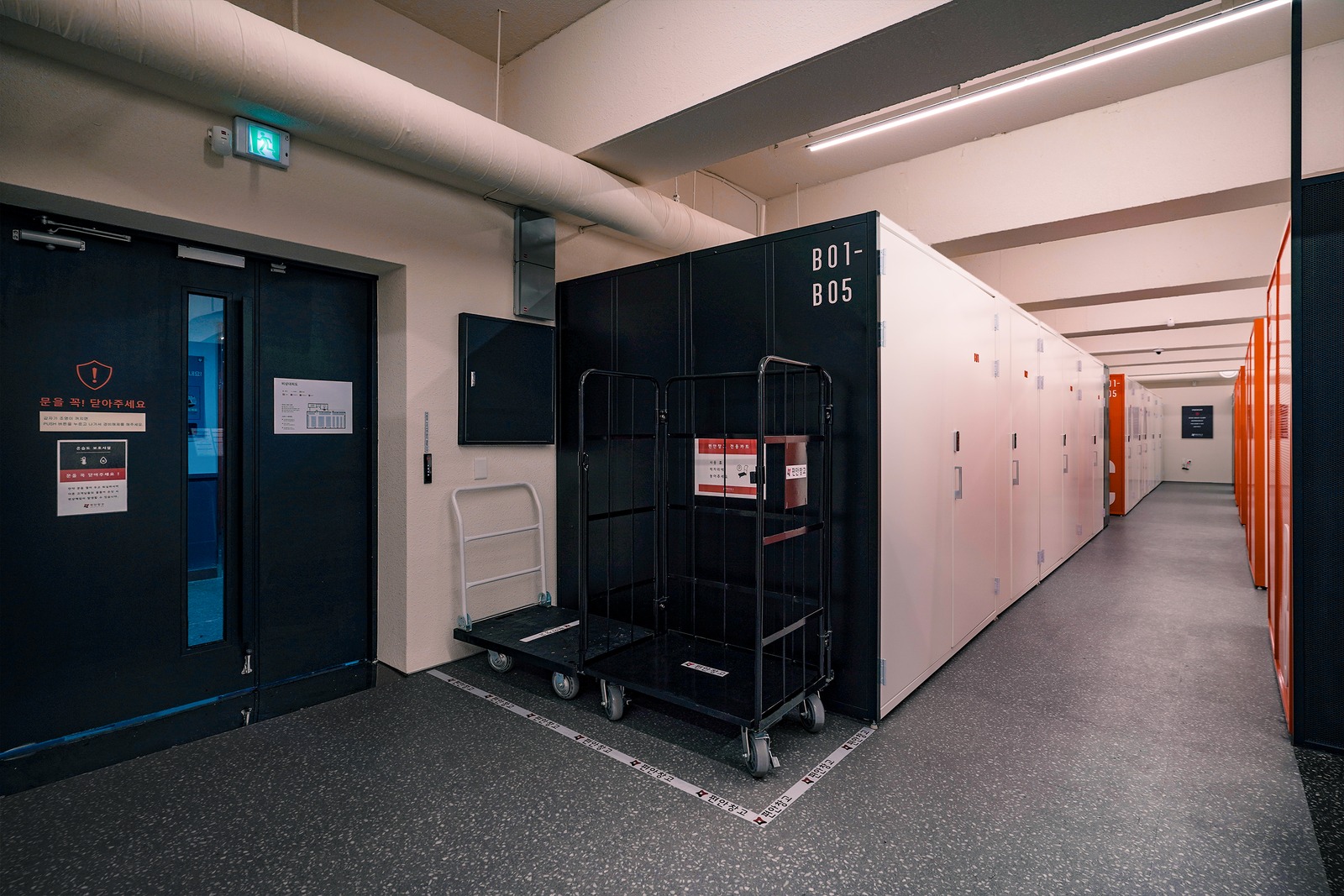
편안창고 (SPACETIME) is a premium self-storage brand directly operated by SIGONGTECH, which has built dedicated storage facilities for over 1,000 museums and cultural institutions in Korea and abroad — including the National Museum of Korea, the National Museum of Modern and Contemporary Art, the National Assembly Library, and the Samsung Museum — over roughly 40 years. That same museum-grade storage standard is applied directly to 편안창고’s units.
Museum-grade storage environment: 편안창고 applies MUBIC coat, SIGONGTECH’s own patented material — humidity regulation, antifungal and antibacterial properties, VOC absorption and breakdown, all built in. It’s a different tier of storage environment from an ordinary facility.
100% floating-floor system: every unit is structurally raised off the ground, cutting off the risk of condensation or flood damage at the source.
Fire-resistant, non-flammable materials: the building itself is constructed to resist fire, adding an extra layer of safety for whatever’s stored inside.
S1 security, CESCO pest control: professional security and pest-management firms manage the branches systematically.
Comprehensive liability insurance worth roughly ₩1 billion, at no cost to you: if something does go wrong, compensation is handled with zero extra cost to the customer — it’s built into the base contract, not a separate paid product.
Free hanging rail and shelf as standard: a hanging rail and a shelf come installed at no extra charge, giving you a setup that’s already optimized for clothes storage.
100% directly operated: every 편안창고 branch is run directly by the head company itself, so you get the same management standard and service quality regardless of which branch you use — the only 100% directly-operated premium self-storage brand of its kind in the industry.
A note worth keeping in mind if you’re new to Korea
If something ever goes wrong with a storage unit, dealing with it is far less stressful when the company behind it is large, financially transparent, and directly operating its own branches — rather than a smaller operation you can’t easily verify from abroad.
FAQ
Q. Why does clothing specifically need this level of storage environment?
Fabric is unusually sensitive to humidity — sustained dampness raises the risk of mold forming inside the fibers, and long storage in a sealed, poorly ventilated space can lead to odor and discoloration. A raised floor, humidity control, and antifungal wall material all directly affect how clothing comes out months later.
Q. Does more branches automatically mean a more trustworthy operator?
Not necessarily. Under a franchise structure, individual branches can vary significantly in how well they’re managed, so branch count alone doesn’t guarantee a consistent standard. It’s worth checking whether branches are directly operated by the company itself or run under a franchise/licensing model.
Q. What should I check about insurance before signing a contract?
Confirm whether comprehensive liability insurance is already included in the base contract, and whether compensation is structured to require no extra cost from you if something goes wrong. Some operators sell insurance as a separate paid add-on instead, effectively passing that cost to the customer.
The bottom line
Self-storage genuinely solves the closet-space problem Korea’s four seasons create. Whether it protects your clothing while it’s there comes down to the storage environment, insurance structure, and how the company actually operates its branches — not the price tag or how close it is to your door.
※ Included fixtures and terms can vary by branch. Please confirm current details directly before signing a contract.
Clothes storage built to museum-grade standards
MUBIC coat interior · 100% floating-floor system · Free hanging rail
100% directly operated · ~₩1 billion liability insurance at no cost to you