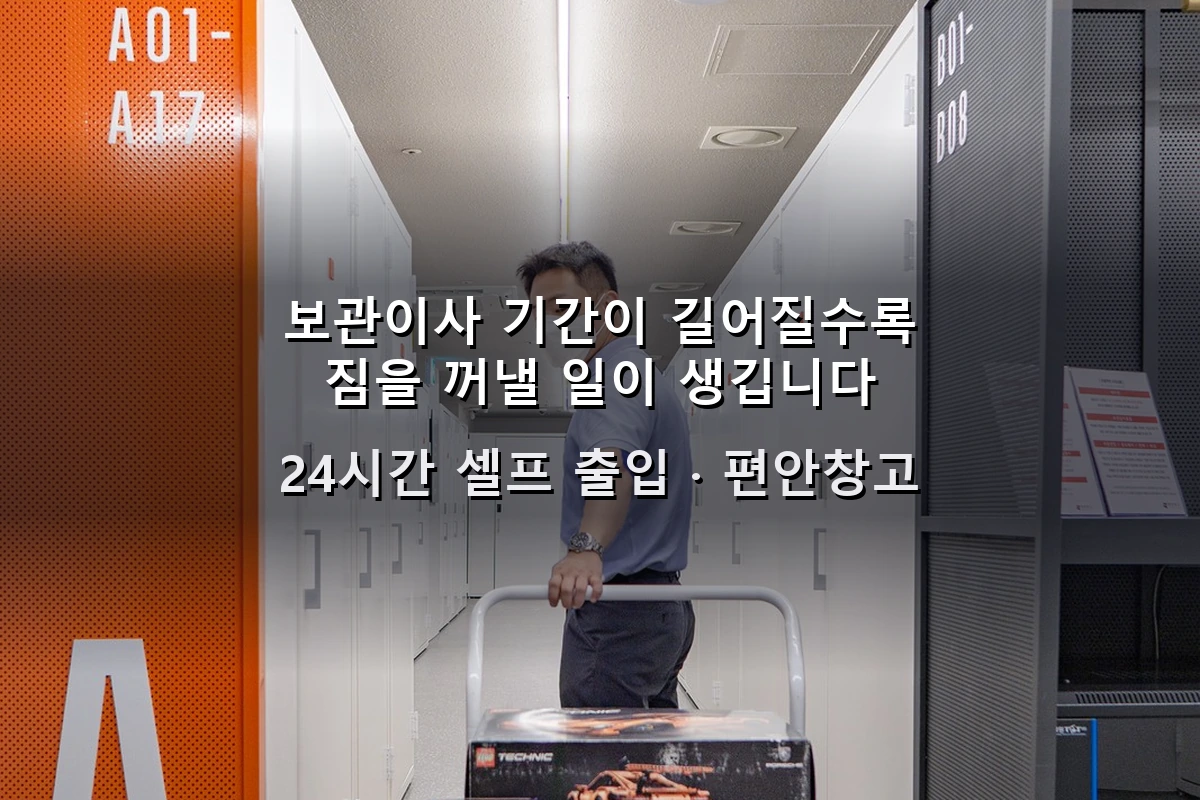
Is your move in Korea stretching out longer than the original plan — a new place that isn’t ready yet, a lease overlap, a renovation running late?
Whatever storage arrangement you picked for the short term matters less the longer that stretch runs.
Because the longer it runs, the more likely you are to suddenly need something out of those boxes.

Two ways to store your things during a long move

When a move needs a temporary storage stop, there are broadly two routes. A moving company can hold your things in its own warehouse as part of an entrusted service — usually stacked alongside other customers’ items, on a schedule the company controls. Or you can rent a self-storage unit and keep everything in your own separate, locked space.
| Entrusted moving storage | Self-storage | |
|---|---|---|
| Getting something out | Needs to be scheduled with the company | Walk in yourself, whenever |
| Access hours | Usually business hours only | 24/7 at most branches |
| Where your things sit | Often stacked with other customers’ goods | In your own separate unit |
| Extending | Usually needs a new quote | Extend for whatever length you need |
What actually happens when you need something out mid-move
A short storage stop of a week or two rarely causes a problem either way — you packed everything, you’ll unpack it soon, done. The picture changes once “temporary” stretches into a month, two months, or longer. Life doesn’t wait for your move to finish, and something you packed away eventually turns out to be something you need right now.
With entrusted storage, getting that one box back usually means calling the company, waiting for an available slot, and sometimes paying a separate retrieval fee — not because anyone’s being difficult, but because your things are mixed in with other customers’ shipments in a warehouse the company runs on its own schedule.
What people actually go back in for
It’s rarely something dramatic. The requests that come up again and again during a drawn-out move are ordinary, everyday things:
Contract documents you thought you were done with. Next season’s clothing and bedding once the weather turns before you’ve moved in. School supplies your kids suddenly need for a new term. Everyday medicine and toiletries you didn’t think to keep out. A tool you need for a repair you didn’t see coming.
None of these are emergencies on their own. But add them up over a two- or three-month delay, and “I’ll just call the storage company” stops being a minor inconvenience and starts being a recurring one.
Having your own space makes the retrieval part simple

With a self-storage unit, that whole recurring problem mostly disappears. It’s your own space, so you go in whenever it’s convenient — most branches operate 24/7 — take out exactly what you need, and leave the rest exactly where it was.
편안창고 (SPACETIME) installs a free hanging rail and shelf in most units, so items you’re likely to need again — like next season’s clothing — can stay organized and easy to grab rather than buried at the bottom of a box. (A few sizes don’t include these, so it’s worth checking for your specific unit.)

If you already know a move is likely to run long — a closing delay, a renovation, an overlap between leases — it’s worth weighing that access difference before you sign anything, not after you’ve already had to make an awkward phone call to get your own winter coat back.
FAQ
Q. What’s the difference between entrusted moving storage and self-storage?
With entrusted storage, a moving company holds your things in its own warehouse, often stacked with other customers’ items, and you generally have to coordinate a pickup time with them to get anything out. With self-storage, you have your own separate unit and can walk in and take things out yourself, on your own schedule.
Q. Which items tend to get requested back out mid-move?
Common ones: contracts and paperwork you didn’t realize you’d need again, next season’s clothing and bedding once the weather turns, kids’ school supplies at the start of a new term, medicine and everyday items, and tools you didn’t expect to need for a repair.
Q. Are the hanging rail and shelves free to use at 편안창고 (SPACETIME)?
Yes, one of each is installed in most units at no extra cost, though a few sizes don’t include them — worth checking for your specific unit before you rely on it.
The bottom line
A quick storage stop rarely reveals the difference between entrusted storage and self-storage. A move that drags on for months makes it obvious — the longer it runs, the more you’ll want your own space you can walk into anytime, not a warehouse you have to schedule a visit to.
※ Access hours, included fixtures, and available sizes can vary by branch. Please confirm current details directly with a branch or through the app.
Your own space, open whenever you need it
24-hour self-access, free hanging rail & shelf in most units
No need to schedule a pickup — just walk in